
Most office chairs get replaced long before anything breaks. The gas lift holds, the frame is straight, the recline works. But the seat smells, the armrests feel tacky, and the wheels drag. That’s a cleaning problem wearing the costume of a furniture problem.
You won’t need anything exotic — a vacuum with an upholstery attachment, mild dishwashing liquid, cloths and baking soda. Budget 30 to 45 minutes monthly, five for the weekly wipe.
Key Takeaways
- Work dry to wet: vacuum first, spot-treat second, deep-clean last.
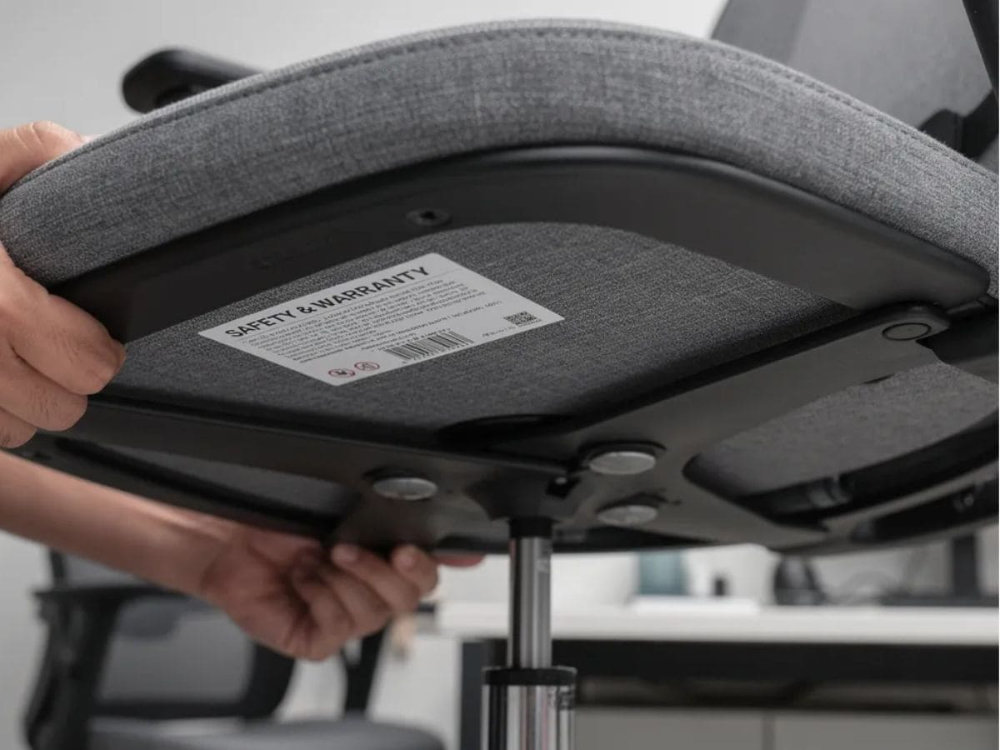
- Check the cleaning tag under the seat before any liquid touches the chair. The W, S, W/S or X code tells you what the fabric survives.
- Foam, not water. Herman Miller’s textile care sheet warns that “excessive wetting of the fabric with any liquid solution may result in permanent damage.”
- Never use hot water on a stain, and never scrub — heat sets stains, scrubbing frays mesh.
- Let the chair dry fully before anyone sits on it.
Before You Start: Identify Chair Type and Check Labels
| How to tell | The rule that matters | |
|---|---|---|
| Fabric | Woven texture, warm, gives when pressed | Foam only — never soak it |
| Mesh | See-through against a light, springy | Dab, never scrub |
| Leather | Cool then warm; genuine hide’s grain is irregular, PU repeats | Clean the whole panel, not the mark |
| Mixed | Mesh back, fabric seat, steel base, PU arms | Treat each part by its own rules |
Prerequisite: Find the Cleaning Tag
Tip the chair forward and look under the seat pan. If nothing’s there, check the lower backrest, inside a seam, or under a cushion. The codes are a furniture-trade convention:
| What you can use | |
|---|---|
| W | Water-based only. Mild soap and water, sparingly. |
| S | Solvent only. Keep water off, ventilate the room. |
| W/S | Either works, with testing and restraint. |
| X | Vacuum and light brushing only. No liquid. |
Check the upholstery cleaning code before using cleaning products. Plenty of contract chairs ship without a tag, though — default to the gentlest method and spot-test where nobody looks, under the seat or the back panel. Wait ten minutes, check for a ring or colour shift, then proceed.
Step 1: Dry Clean First – Dust, Hair & Crumbs
Every wet step goes better once the loose material is gone. Fit the upholstery or soft-brush attachment and work the seat, backrest, sides and seams slowly.
Then use the crevice tool for what the wide head can’t reach:
- The seat-to-backrest junction — the worst offender on any chair.
- Behind the lumbar support and its adjustment track.
- Under the armrests and arm stems.
- The gap between seat pan and mechanism housing.
One caution: don’t use a rotary brush head on upholstery. Herman Miller’s guidance on upholstery fabrics warns that brushing “may permanently damage the nap or change the character of the fabric.”
Step 2: Spot-Treat Spills and Stains
Fresh spills lift far more easily than dried ones, so act the same day.
- Blot — never wipe or scrub. Use a microfibre cloth to blot stains, not rub them. Press firmly, hold a few seconds, then lift straight up. Wiping drives the spill deeper into the foam.
- Work from the outside edge of the stain inward.
- Mix a few drops of dishwashing liquid into warm water. Keep it weak — residue attracts dirt and shows up as a dull patch.
- Dip a cloth, wring it out hard, and dab it into the stain. Never pour solution onto the chair.
- Rinse by dabbing with a second cloth in cool water, then blot dry.
Two rules from Herman Miller’s stain removal instructions apply to most chairs: “Never use hot water; it will set the stain,” and “Several light applications are better than one heavy application.”
Step 3: Deep-Clean Fabric Office Chairs
Fabric seats and stubborn stains need a full clean every few months, and the trick is foam instead of liquid.
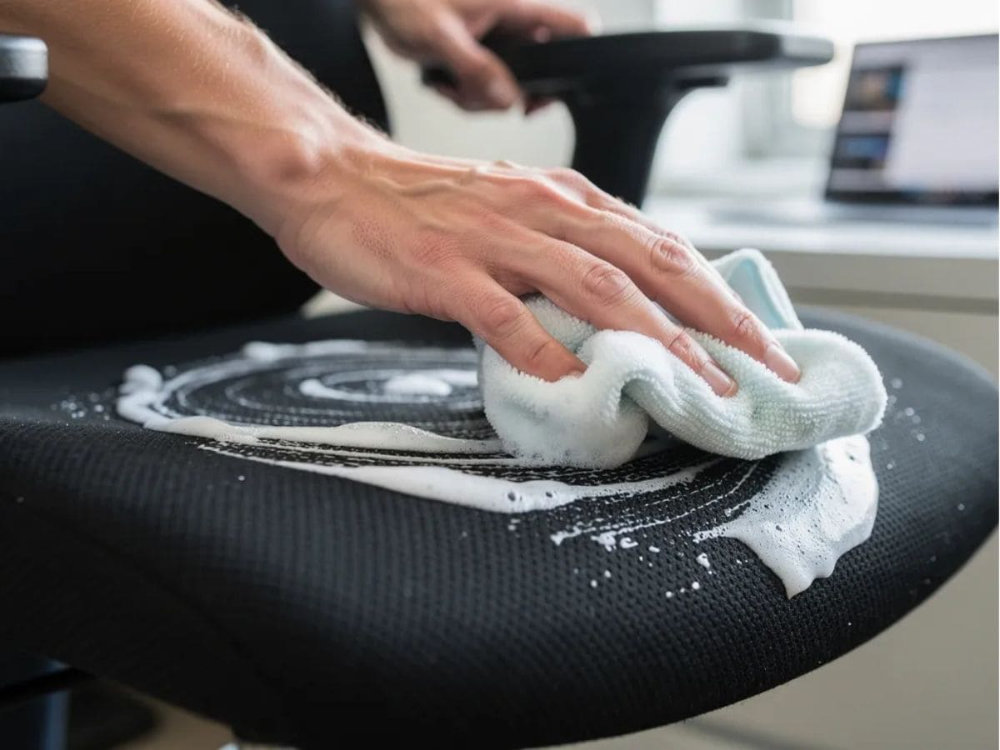
- Whisk a teaspoon of mild detergent into warm water until it’s well foamed.
- Scoop only the foam onto a damp cloth. It carries the cleaner to the surface without soaking the padding.
- Work in sections the size of your hand: apply, lift off with a damp cloth, blot dry, move on.
- Finish each section before the next. Foam the whole seat at once and the first patch sits wet for ten minutes — that’s a water ring.
Drying Is Not Optional
Put the chair under a fan until it’s dry all the way through. Press the seat with the back of your hand — if it feels even slightly cool, the foam still holds water.
Singapore’s mean annual relative humidity sits around 82%. Without air conditioning, air that damp dries upholstery slowly. Once dry, vacuum again — cleaning lifts fibres and loosens trapped grit.
Step 4: Clean and Deodorise Mesh Office Chairs
You can clean mesh office chairs quickly, but it’s the material most easily damaged by heavy handling.
- Mix the same weak soap solution and wring the cloth out until barely damp. Water dripping through lands on the seat mechanism, gas cylinder and anything electrical below.
- Gently wipe in one direction, dabbing at marks. Scrubbing frays strands and leaves a fuzzy patch for good.
- Follow with a plain-water pass. Soap left in the weave attracts dust and goes grey.
Deodorising with Baking Soda
- Sprinkle a light, even layer over the mesh seat — enough to dust it, not coat it.
- Leave it 20 to 60 minutes to absorb moisture and smells.
- Vacuum it off on the lowest suction setting, head moving. High suction pulls the panel out of shape and stresses the clamped edge.
Skip this on very fine or open-weave mesh, where powder works into the frame channel.
Step 5: Care and Cleaning for Leather Office Chairs
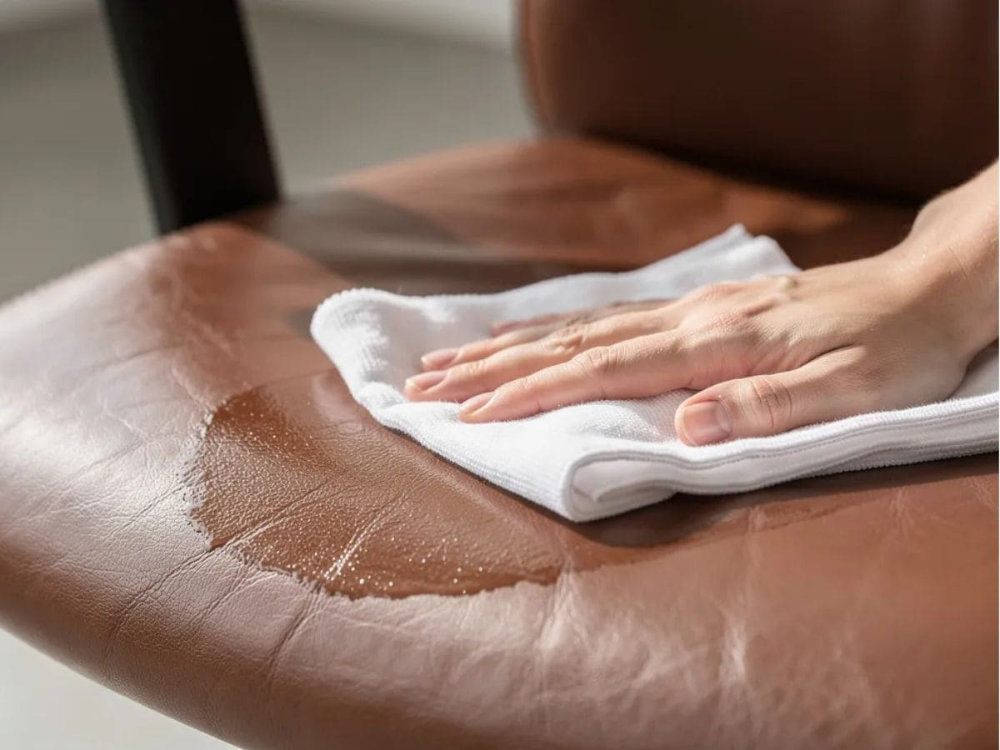
You clean leather office chairs less often than fabric, but more consistently. Use a soft brush attachment to vacuum leather chairs. Loose grit scratches the finish. A soft cloth barely dampened with water, used weekly, stops skin oils building into dark, shiny patches.
For a deeper clean, use a mild soap lather or leather cleaner. One detail catches people out: clean the whole panel, not the mark alone. Herman Miller’s leather care instructions state it plainly — “Do not spot clean leather; clean the entire surface.” A single cleaned patch leaves a halo harder to fix than the stain.
| Do | Don’t |
|---|---|
| Wipe weekly with a barely damp cloth | Spot-clean a single mark |
| Clean the entire seat or back panel | Use saddle soap, solvents, oils, polish, varnish, abrasives, detergents or ammonia |
| Rinse, dry with a soft cloth, air-dry | Use a hair dryer or heat source |
| Condition genuine leather 2–4 times a year | Condition bonded leather or PU |
Conditioning Every Three to Six Months
Work a small amount over the surface in circles, leave 10 to 15 minutes, then buff off the excess. This matters more in air-conditioned offices than people expect: cooling strips moisture from indoor air, which then pulls it from leather.
Skip conditioner on bonded leather and PU — the coating won’t absorb it, so it sits on top as a sticky film that collects dust.
Step 6: Hard Surfaces – Armrests, Frame, Base, and Wheels
- Steel and metal frames on AFC office chairs clean up with mild soap and warm water. Wash, rinse, then dry every surface completely. Herman Miller says the same for chair bases and frames, adding: “Do not use solvents or abrasive kitchen cleaners.”
- Drying isn’t cosmetic. Water around a bolt head causes watermarks first, corrosion later. Check the base arms and gas cylinder recess.
- Plastic armpads and levers take a damp cloth and a dry buff. For grooves and grips, use a cotton bud.
Clean Office Chair Wheels
Office chair casters should be cleaned to maintain smooth rolling. They’re the job everyone skips.
- Lay a towel down and turn the chair upside down so the base faces you.
- Pull hair and thread out by hand. Tweezers help with material compacted around the axle; a seam ripper gets under tight wraps.
- Wipe each wheel, clear the gap between the twin wheels, check the stem socket.
- Dry them, then spin each one.
Clean chair wheels every three months for optimal performance. Office chair wheels that bind drag across flooring and wear unevenly.
Step 7: Disinfect High-Touch Areas Safely
Regular cleaning minimises the spread of germs. Disinfecting the whole chair is unnecessary, though. Focus on what hands actually touch:
- Both armrests, top and front edge
- Height and tilt levers, and any paddle under the seat
- The front and side edges of the seat
- The top of the backrest, which everyone uses as a handle
Dampen a cloth with 70% isopropyl alcohol and wipe. Never spray disinfectant directly onto the chair — spray lands unevenly, soaks into seams and leaves patches.
Concentration matters. The CDC’s guideline on chemical disinfectants puts “the optimum bactericidal concentration” at “60%–90% solutions in water,” with activity that “drops sharply when diluted below 50% concentration.” Neat 99% alcohol is weaker here, not stronger.
It also notes alcohol can “swell and harden rubber and certain plastic tubing” with repeated exposure. Test a hidden spot on PU armpads and keep alcohol off leather. Avoid bleach-based wipes on office chair upholstery.
Step 8: Drying and Reassembly – Don’t Rush This Step
- Park it near an open window, under a ceiling fan, or in an air-conditioned room.
- Keep it out of direct sunlight, which fades dark fabrics and dries leather too fast.
- If the foam feels heavy, press a dry towel into it with your palm, section by section. Never wring or twist upholstery.
- Reattach removed parts only once every section is dry. Headrest posts, armrest mounts and the seat pan underside dry last.
Bolting damp components together traps moisture — the recipe for a musty chair two weeks later.
Why Cleaning Your Office Chair Matters
What accumulates is predictable: crumbs, skin oils from forearms, dust, and whatever gets knocked over on a Monday morning. Fabric, mesh, leather, armrests and wheels all collect it, and the result is odour and the warm, soiled conditions bacteria favour. Dust and allergens in chairs can trigger respiratory problems.
There’s a wear cost too. Grit in upholstery acts as an abrasive under body weight, which is why neglected fabric wears at the front seat edge. Skin oils soften armpad coatings until they go tacky.
How often should you clean your office chair?
There’s no single number. It depends on how hard the chair works and where it lives.
| Time | What to do | |
|---|---|---|
| Weekly | ~5 min | Wipe high-touch areas; vacuum the seat and back |
| Monthly | 30–45 min | Full vacuum, spot-treat marks, clean frame and armrests, clear wheels |
| Every 3–6 months | 1–2 hrs | Deep-clean fabric or mesh; condition leather |
Adjust for the setting. A private office chair needs less than an open-plan hot-desk shared by three people. A dormitory or common room sits at the far end: more users, longer hours, more food. Humid air slows drying too, so deal with spills immediately.
Quarterly inspections catch problems early and save costs. That matters across a floor of identical chairs. Durability and maintenance belong together: AFC’s steel furniture and storage systems are specified for institutional and government settings, where cleaning runs on a schedule and equipment is handled by many people.
Frequently Asked Questions
How can I clean my office chair quickly during a busy workday?
Give yourself five minutes. Wipe both armrests, the seat edges and the top of the backrest with a cloth dampened with 70% isopropyl alcohol, and blot any spill. Leave deep cleaning for a day the chair can dry properly — a damp seat at 2pm is worse than a dusty one.
Is it safe to use baking soda on every chair type?
No. It works well on fabric and standard mesh, absorbing odour and vacuuming away cleanly. Keep it off leather and PU, where the mild abrasiveness dulls the finish, and off any chair tagged X. On fine mesh, test first and vacuum on low suction — powder in the frame channel is hard to retrieve.
Can I steam-clean my office chair?
Usually not. Herman Miller’s textile care guidance says “do not use steam” for its seating and workspace fabrics — heat and moisture together shrink fibres, set stains and separate glued layers. If your manufacturer permits it, use the lowest setting and test a hidden area. Otherwise the foam method in Step 3 is safer.
What should I avoid when cleaning a leather office chair?
Avoid saddle soap, solvents, oils, furniture polish, varnish, abrasive cleaners, strong detergents and ammonia — Herman Miller warns these ruin the finish and leave it sticky and cracked. Also avoid spot cleaning a single mark, and never dry leather with a hair dryer.
How do I keep my office chair cleaner for longer?
Small habits beat big cleans. Eat away from your chair. Deal with spills within minutes, not hours. Wipe armrests weekly, where oils build fastest. Using chair covers reduces the need for deep cleaning. Vacuum the seat fortnightly. Clear the wheels monthly. Run a fan after any wet clean.
